
Jeanne Gang, FAIA
Founding Partner, Studio Gang
There are buildings, and there are birds. Where they encounter each other is the space, physically and philosophically, where architect Jeanne Gang works.
The birds came first. For millennia, they’ve followed a migration route called the Mississippi Flyway to travel thousands of miles from north to south and back again. Each spring and fall, countless birds soar along the flyway as it hugs the western shore of Lake Michigan. It funnels them toward places where there’s food and water. It funnels them toward parks and trees where they can rest tired wings. It funnels them toward Chicago. And buildings.
More than one billion birds die every year in the U.S. by crashing into building glass as they migrate. Jeanne Gang, a MacArthur Fellow, one of Time magazine’s “100 Most Influential People” in 2019, and most recently the 2026 Thomas Jefferson Foundation Medalist in Architecture, has been trying to find solutions to this issue as part of the work she leads at her architecture and urban design practice Studio Gang.
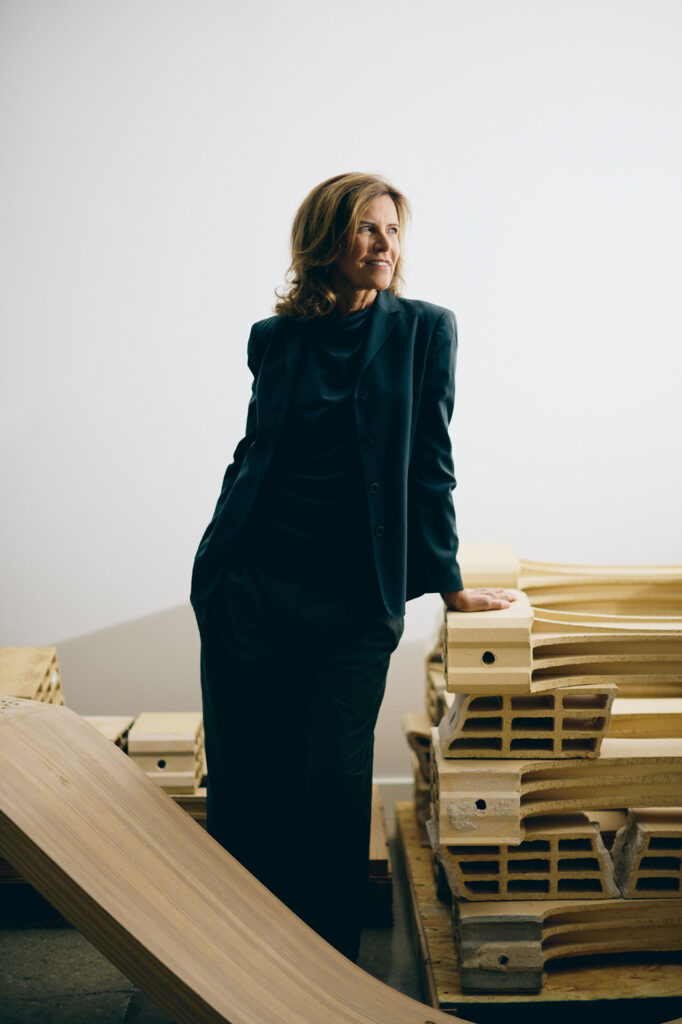
Today, you can’t scan Chicago’s skyline without seeing one of Gang’s buildings. Yet in a time when ‘name’ architects sometimes design structures that seem more an homage to themselves than an answer to a client’s need, it’s impossible to spot a ‘signature’ Studio Gang building. Each is a bespoke response to the client and their world: low ego, high empathy.
Gang might be one of the most celebrated architects of her generation, but she always sees herself working in a bigger context. There is the natural world and there is the urban world—and often the twain shall meet. How can living beings of every kind (two-legged and otherwise) live in harmony with homes side by side?
“I always say, ‘Start with what’s there,’” she remarks. “It’s an approach that comes out of my understanding of the natural world. Other organisms function by working with what’s already there. So, I apply that approach to what I do as an architect.”
It’s an approach to design that emerged from growing up in Belvidere, IL, 90 miles west of Chicago, a tomboy who liked “climbing trees, being outside, getting dirty,” she laughs. Gang was the third of four girls. Her mother was a librarian and community organizer, always reading and passionate about the environment. Her father was a civil engineer, responsible for the roads and bridges of Boone County, IL.
He was also a “girl dad.” “Sometimes I would wake up super early and get hot chocolate with him at this coffee shop called The Huddle,” she says. “His guy friends would be there, and someone would say, ‘Too bad about all those girls, Jim. We’re pulling for you to have a son.’ He would always say, ‘Are you kidding? I wouldn’t trade having girls for anything.’”
Family vacations were long car trips across the U.S. that usually included visiting a famous bridge somewhere. The drives introduced Gang to the American landscape, which she came to love. Wondering what to study in college, Gang discovered that architecture combines art with math and physics and, “I never looked back,” she says.
After graduating from the University of Illinois Urbana-Champaign and Harvard Graduate School of Design with degrees in architecture, Gang worked for two years with “starchitect” Rem Koolhaas and OMA (Office for Metropolitan Architecture) in Rotterdam. Then she went to Booth Hansen in Chicago. In 1997, she was ready to open her own practice.
Early commissions for Studio Gang included smaller-scale projects—a community center, single family homes, university buildings. Then, in 2004, a chance meeting led to a new opportunity: Design a skyscraper in downtown Chicago.
“Chicago is one of the best architecture cities in the world,” says Gang. “It’s on the cutting edge when it comes to sustainability. But there’s also an openness to experimenting here.”
Gang had never designed a skyscraper before, but she dove in. The result was the Aqua Tower, an 82-story structure draped in undulating balconies that recall the rippling waves of nearby Lake Michigan. Not only was the Aqua visually striking; it was brilliantly engineered. One of Gang’s early projects had been an exhibition about NASA wind tunnels. It talked about how buildings perform under different wind conditions. That taught her how to “break up” the winds that typically buffet Chicago skyscrapers. But the curvilinear balconies of the Aqua did more: They shielded residents from the sun while creating sightlines for contact and conversation between units and floors.
With the debut of the Aqua Tower, Studio Gang burst onto the scene. The project won a fistful of awards in 2009. More followed, plus a flurry of commissions: the Nature Boardwalk at Lincoln Park Zoo; the Arkansas Museum of Fine Arts; the U.S. Embassy in Brasília; the Richard Gilder Center for Science, Education, and Innovation at the American Museum of Natural History in New York; the St. Regis Chicago skyscraper; and many, many more. Today, Studio Gang has offices in four cities and projects in the U.S. and abroad (including design work on the new Global Terminal at O’Hare).
Accolades have continued to pour in, too. Gang won a MacArthur Foundation “genius grant” in 2011; the American Institute of Architects has honored Studio Gang’s work more than 50 times. CBS News “Sunday Morning” called Jeanne Gang “arguably the most important woman architect anywhere.” Studio Gang has been invited to create and display work for the Venice Biennale four times, one of the most prestigious exhibitions of contemporary art and architecture in the world.
A woman in a profession that’s historically been mostly men, Gang is close to becoming a household name. Yet the truth about women in architecture is nuanced: More than half of all U.S. architecture students and graduates are women, as are 46% of candidates for the architecture license. Only about 25% of women continue in the practice, though. “It’s clearly not a gender-specific skill,” says Gang, “Women make great architects, but it’s a profession that can be difficult for women to navigate for different reasons.” (One of the reasons is sustaining work/life balance during a woman’s childbearing years.) At Studio Gang, the mix of men and women is about 50/50.
In 2022, the Women’s Leadership Center at Williams Bay chose Studio Gang to be its architect. As the campus opens in 2026, the results are amazing—an extraordinary marriage of art and nature, engineering and design. The campus is a master class in sustainable architecture and construction, sensitively sited in an old-growth oak forest overlooking Geneva Lake.
“Our design responds to the natural beauty and ecology of the site. For example, the roof is designed to deliver light deep into the interior spaces like the gaps in the tree canopy,” says Gang. “The idea was to create different spaces that create unique opportunities for gathering, reflection, and experiencing nature.”
One of Studio Gang’s principles is “actionable idealism,” or a philosophy of finding ways to keep acting on and pursuing—even in small ways—the things that create positive change. It’s a mindset that says, “just keep trying and never give up,” she says.
It’s a value set she and her team bring to urban design. “I want to bring nature back into the city and create buildings that limit their impact on the planet,” says Gang. She wrestles daily with ways that architects can use design to educate and motivate people. “Before you put your mark on a place, you have to understand it and develop a sense of care for the people, the site, the context that’s there,” she says. “Like a plant: If you put it in the wrong soil, it won’t thrive. You need the right conditions to support a living thing, and I think of architecture as a living thing because it comes to life through people. It becomes part of their ecosystem.”
And so, when Gang visits a new city or place, she makes a point of birdwatching. After all, if you’re going to create spaces that work for everyone, with homes for creatures big and small, it helps to know who’s living there.
“So many living beings are threatened right now,” says Gang. “How can we do a better job of co-existing with animals, plants, and other species on earth,” she asks, “and not hurt them?”
Portrait Images Credit: © Chris Strong