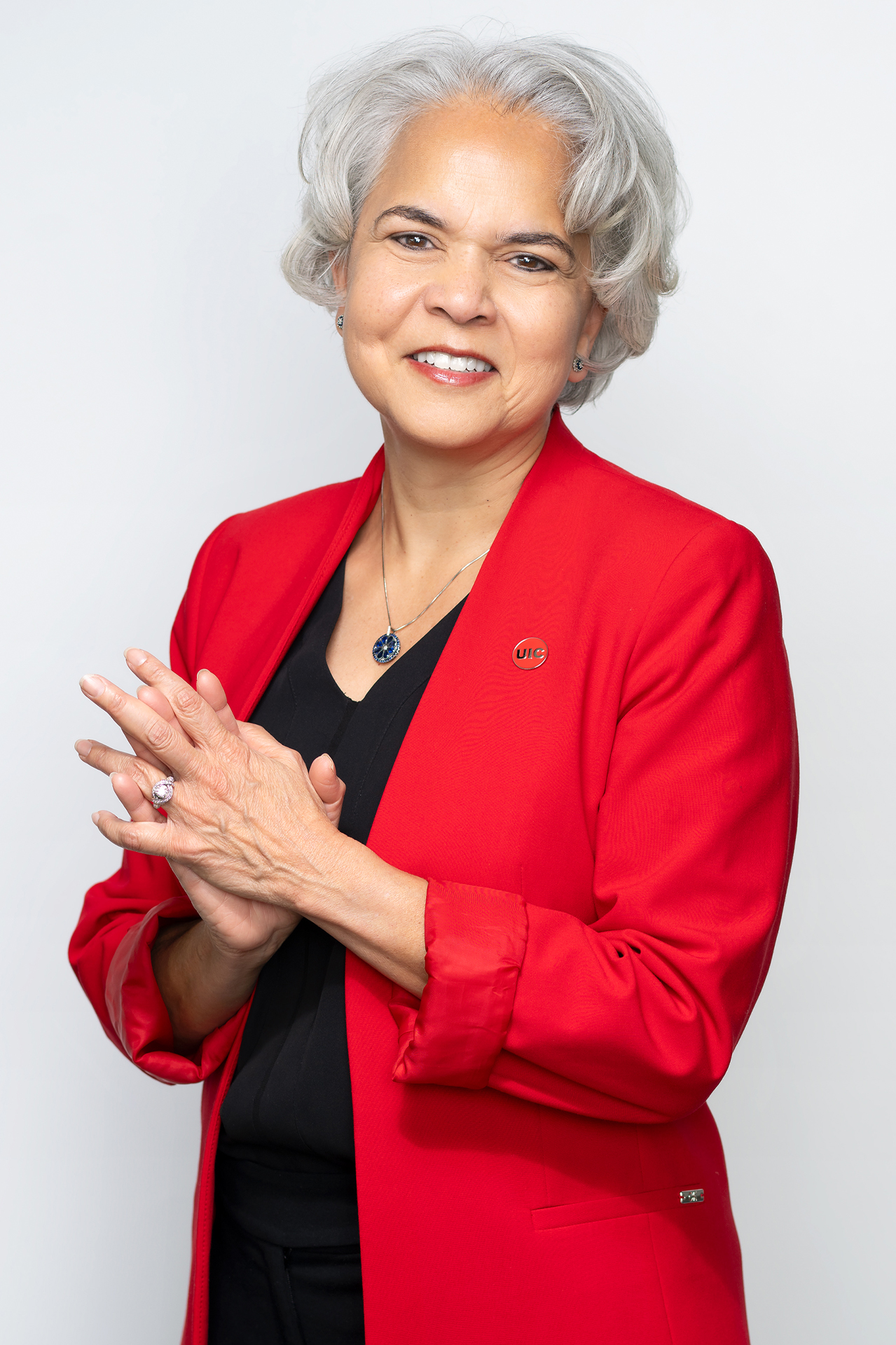
Marie Lynn Miranda, PhD
Chancellor, University of Illinois Chicago
Imagine you spy a honeybee in your garden. You automatically know three things: Like 90% of all honeybees, that lovely creature is likely female. She is brilliant at geometry; building a honeycomb is precise, demanding work. And what keeps her going—the reason she willingly works her wings off—is dedication to the greater good. She lives to see the hive thrive.
There is a farm in northwest Indiana where such honeybees live—about 200,000 in winter but close to a million in the summer. “I love everything about beekeeping,” says Dr. Marie Lynn Miranda, who shares the farm and the bees with her husband and two English setters when she’s not deep in another hive of activity—the University of Illinois Chicago (UIC). “Bees are some of the most talented mathematicians I know. I get to hang out with all these great geometricians and trigonometricians.”
In 2023, Dr. Miranda became the 10th Chancellor of UIC, the largest and only public research university in Chicago, meaning it has a special focus on generating new knowledge (not just sharing existing knowledge) while serving the community. It’s a school known for the diversity of its students and for high social mobility, or support for students to climb the economic ladder.
Dr. Miranda knows their story in her bones. Her parents immigrated from Goa (a state on the southwestern coast of India) shortly before she was born. While her father worked as a civil engineer and then professor at the University of Detroit, Marie Lynn’s mother ran a household that included Marie Lynn, her three older brothers, her grandmother, her grandmother’s two sisters, plus (for a time) a cousin, his wife, and their three children. Also, any other family members who needed a place to stay as they immigrated to the U.S. “It was a big, noisy immigrant family with food and people and dancing breaking out right and left,” she says.
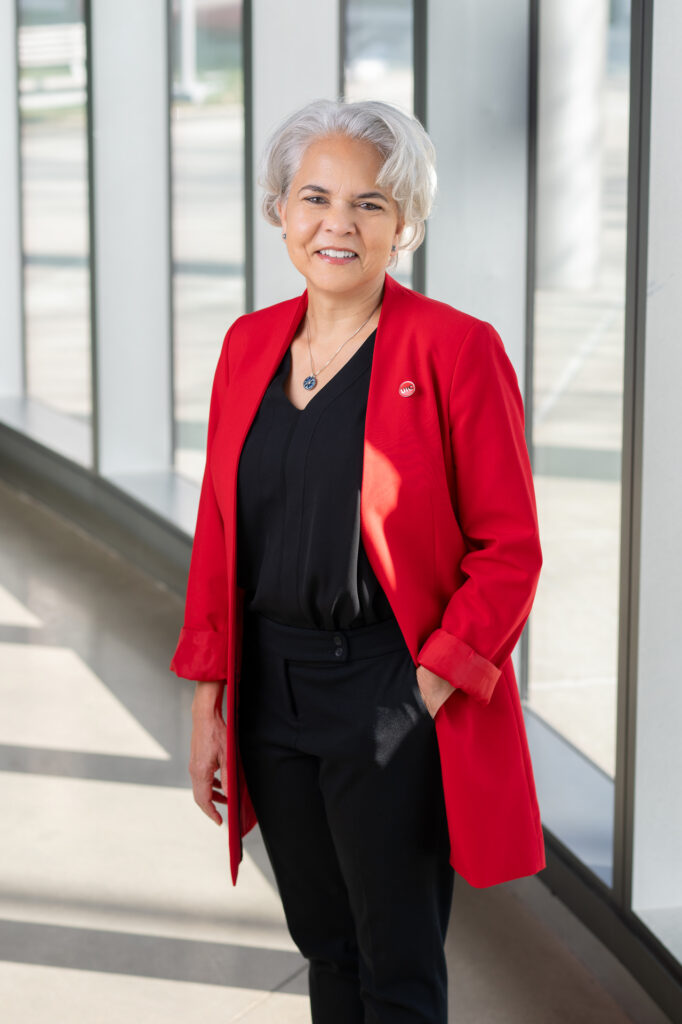
In Detroit, it was a different time to be a kid. “I could be out riding my bike for six hours and nobody worried,” she says. Actually, the one place she needed to be on her toes was at home. With three older brothers, “I grew up tough,” she says. One day her oldest brother sat on her and cut off all her eyelashes. When her mother demanded to know why she’d let him do that, she replied, “Because there were scissors near my eyes.” She laughs, remembering. “It was the first time I thought to myself, ‘The world is not just.’”
Her father loved having a daughter, and he really loved having a daughter who loved math the way he did. A much-honored professor in the School of Engineering for decades, Marie Lynn wrote of him when he died, “He made sure we knew we were deeply loved, that we all learned calculus, and that we all got out on the dance floor.”
Marie Lynn made him proud. She won a full scholarship to Duke University, where she was Phi Beta Kappa and majored (of course) in math. There, she worked for the legendary basketball coach Mike Krzyzewski, or “Coach K.” How he built and led teams and communicated both high standards and high caring impressed her. Graduate school took her to Harvard to earn an MA and PhD in Economics and a National Science Foundation Graduate Research Fellowship. Her heart pulled her toward environmental science, so she went to work for the U.S. Forest Service while still in school. The Forest Service softball team at the time needed women. Marie Lynn protested she didn’t have time. But she could (as the younger sister of three boys) make the throw from third base to first, and that earned her a position. The shortstop was a guy named Chris. Three children and thirty-five years of marriage later, they are still a team.
Her love of environmental science continued. Marie Lynn returned to Duke in 1990 as faculty and in 1999 became director of undergraduate programs at the Nicholas School of the Environment. A self-taught toxicologist, she also founded the Children’s Environmental Health Initiative in 1998 and still serves as its director. In 2011, she went to the University of Michigan as a professor and Dean of the School of Natural Resources and Environment. Rice University hired her away in June 2015 to be their provost and a professor of statistics.
“I’ve never really thought about what position I want to have,” she says. “I’ve just thought about the work I want to do and the outcomes I’m trying to affect. It never occurred to me to say, ‘Oh, I want to be a provost or dean.’ It was more, ‘Where can I shape curriculum? How can I guide the educational experience for students and for faculty as researchers?’”
At Rice, everything was going very well … until it wasn’t. In 2018, her youngest child was diagnosed with cancer. The best place to treat her was in Michigan, a thousand miles away. “I didn’t feel like I could be both the provost my university deserved and the mother my daughter deserved at the same time,” she remembers. So, Marie Lynn left Rice and moved to Ann Arbor. When her daughter lost her hair to chemotherapy, Marie Lynn shaved her head, too.
But “My husband likes to say it’s important to keep me busy lest I end up in jail,” she laughs. In 2020, as her daughter’s health improved and with a pandemic impending, Notre Dame came calling. Marie Lynn was ready to work again and joined them as provost.
Her respect for Notre Dame is high. But after a time, she realized her heart was calling her elsewhere. She wanted to contribute to something bigger—to be someplace where students from low-resource communities and diverse backgrounds were working to create more for themselves. And the data scientist in her wanted to be in an institution dedicated to research with a major academic medical center.
As Chancellor of UIC since 2023, “I tell people, ‘I have the best job in Chicago and the best job in higher education,’” she says. (In addition, she is also a Professor of Pediatrics and Mathematics, Statistics, and Computer Science.) Beyond UIC, Marie Lynn serves on the Board of the Doris Duke Charitable Foundation and the Board of the Environmental Defense Fund. She is a fellow of the American Association for the Advancement of Science and a member of Sigma Xi, an honor society for scientists and engineers.
“More than half of UIC’s students are the first in their family to go to college,” she says. “Our clinics provide care to the most underserved communities in Chicago. We’re ranked number one in Illinois in social mobility, and number nine nationally.” And yet, “Our resources are so limited. This job is ten times harder than my last job. But it’s so meaningful every day.”
She glances out her window at a winter afternoon; peregrine falcons are taking up residence on her sill.
“Sometimes the things you want seem totally different, conflicting,” she continues. “Like, I really loved math. And I really wanted a job where I could help people. How do you combine those? Or how do you combine loving being a mother and loving your job?”
Beyond and below her office, the streets of Chicago stretch to the horizon. Beyond Chicago, in a corner of Indiana, is a farm. On it, bees are dancing. They are caring for the hive, working hard, making exquisitely good honey. They are doing incomprehensibly intelligent math building honeycomb and signaling flight patterns to good nectar to their hive-mates. One imagines they are happy. “Here’s the thing,” says Marie Lynn. “Don’t think about the trade-offs. “Don’t think about the either/ors in life. Because it won’t always be like that. Instead, work to find a way to do the things you love together. And it will come to you.”