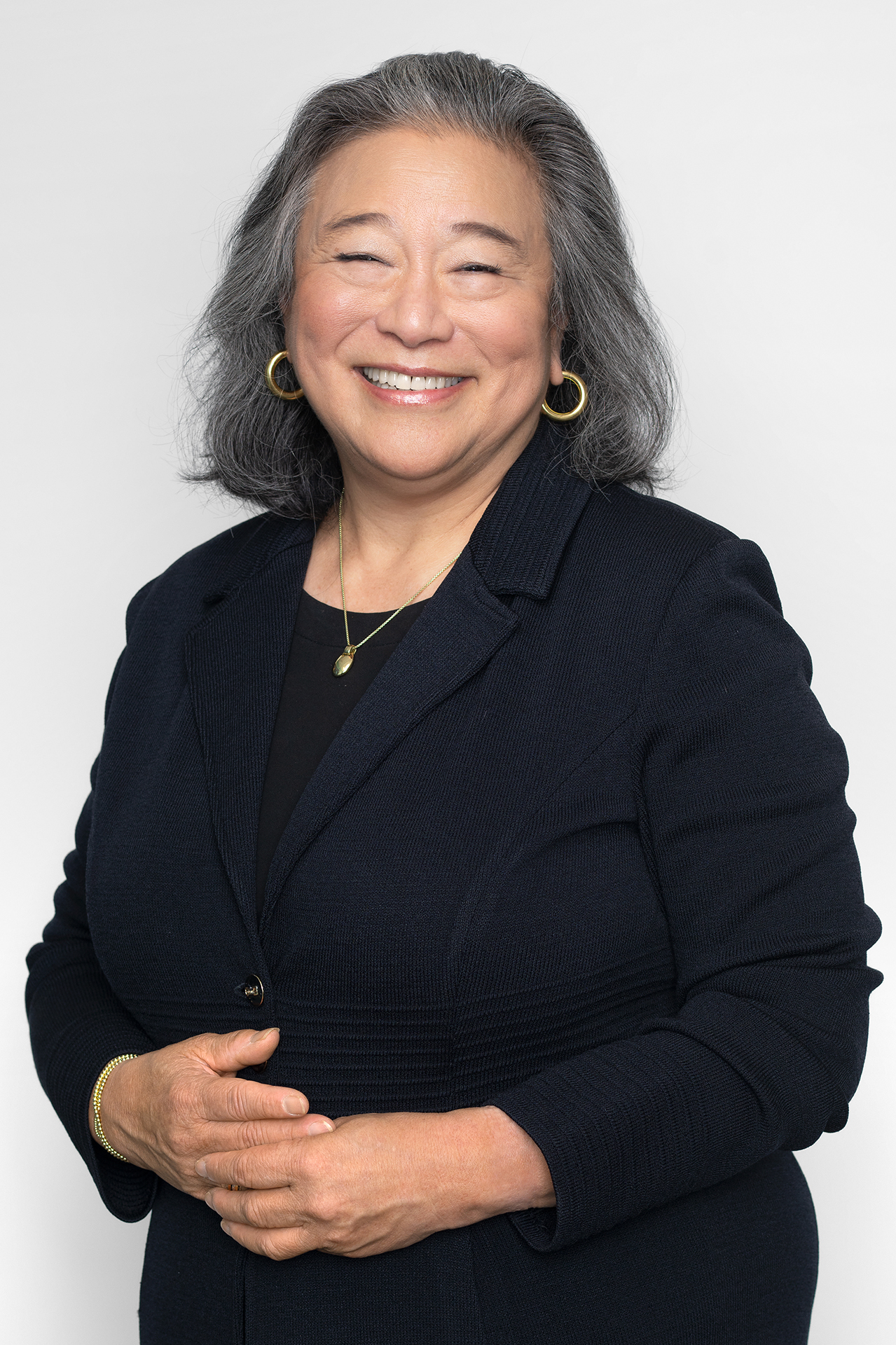
Christina “Tina” Tchen
Executive Vice President for Programs, Obama Foundation
Tina got used to being stared at when she went to the grocery store. “Growing up, we lived in a place where there weren’t other Chinese people—I mean, on purpose,” she says. “One reason we settled in Cleveland was because my father heard stories about discrimination in places like New York and California. And he thought we would be safer where there weren’t lots of other Chinese people.”
So, Tina and her younger sister got used to being stared at. Or asked, “Do you speak English?” Actually, what Tina didn’t speak was Chinese. Born in Columbus, Ohio, Tina was as American as apple pie. But in the 1950s and 1960s, assimilation was the game. You wanted to fit in.
And Beachwood, Ohio, a suburb of Cleveland, was a good place to do it. Beechwood’s population was 95% Jewish when Tina grew up there. It was welcoming. It was peaceful. The schools were good. Most important, it was worlds away from the terror and turmoil of the Chinese civil war.
In 1949, the Communist Party took control of China after decades of struggle against the Chinese Nationalist (Kuomintang) Party. Millions had died. As the Communists took charge, millions more fled, including Tina’s parents. They’d grown up with wealth and privilege, in families close to the Kuomintang. They left behind their parents and most of their relatives, hoping to come back after things settled down. But the Communists slammed the door on those who left. And Tina’s father and mother—a psychiatrist and a scientist—found themselves building a new life in America, cut off from home.

In the background as Tina grew up was always this quiet drumbeat: Pride. You may not look like everyone else, but you come from substance. Chinese culture is thousands of years old and profound and rich. Don’t act Chinese but don’t forget you are Chinese. Most of all: Excel. You’re going to Harvard.
So, Tina and her sister learned to ignore the stares and questions. As the saying went: Never complain, never explain. “We didn’t talk about it at home,” she says. “I think a lot of children of immigrants have stoic parents, especially given the culture my parents came from. You didn’t talk about feelings. You didn’t hug each other. That sense of being an ‘only’ but also trying to assimilate? It prepared me for a lot of what happened.”
And Tina did as asked: She achieved. She was class president her freshman, sophomore, and junior years, then president of the student council her senior year. She edited the school literary magazine. She was a cheerleader. And, when time came, she got into Harvard.
By then, she was already interested in politics. At age 12, she volunteered in Eugene McCarthy’s 1968 presidential campaign. At Harvard, she wanted to study government, but the department head was such a noted conservative that she opted to study Sociology instead, “which was a more flexible way of taking government classes,” she laughs. She graduated in 1978. Two weeks later, she got married.
“All I can say is,” Tina sighs, “don’t get married two weeks out of college.”
Tina’s new husband was from Illinois, and she followed him to Springfield where he was working for Governor Thompson. Tina eventually went to work for Thompson, too, as an analyst for the Department of Child and Family Services at the state’s Bureau of the Budget. In a free moment, she stuck her head in the door of the Springfield chapter of the National Organization for Women (NOW) to help out. They were working on getting the Equal Rights Amendment (ERA) ratified in Illinois, which was key to getting the last three states needed to make the ERA part of the US Constitution. “I showed up to volunteer and never left,” she says. “Fifty years later, those people are some of my best friends.”
Being Tina, she became president of the Springfield NOW chapter and spent lunch hours listening to Illinois Senate hearings and protesting in the State Capitol rotunda. By the time she started law school in 1981, she was vice president of the Illinois NOW chapter and deep into politics. She supported Harold Washington’s successful bid to become Chicago’s mayor 1983 and helped found Cook County Democratic Women.
“That’s how I learned to be an organizer,” she says. “I destroyed the carpet in one apartment because I kept running a mimeograph machine. I got duplicator fluid all over the floor.”
After the fight to ratify the ERA failed, Tina and five other women decided to rewrite the rape laws on Illinois’s books. Law school was preparing Tina to focus on policy work, not just litigation. She also was learning to love being a litigator, so she hoped to combine those interests at a significant, established law firm. The place she eventually landed was Skadden, Arps, Slate, Meagher & Flom.
Skadden was already building a reputation for aggressive, deft work handling mergers and acquisitions, including hostile takeovers. The firm was founded by Jewish lawyers who’d been shut out at the prestigious, “white shoe” law firms in New York. So, the company came with an attitude and a history of taking on injustice via pro bono work.
The Chicago office was small when Tina joined them in 1985. It was an interesting time in Chicago politics. Richard M. Daley was the new mayor following Harold Washington’s death in office in 1987. “Illinois was a mostly anti-choice state governed by Democratic Catholics,” says Tina. “So, the progressive Democrats in Chicago all knew each other.” That is how, somewhere in the mix, Tina met a community organizer named Barack Obama.
She worked on various of his campaigns and they clicked. When Obama ran for president in 2008, Tina was one of his most successful fundraisers. She hadn’t set her sights on going to Washington when she started working in politics. Her 23 years at Skadden were rewarding, and Tina relished the stability corporate life gave her; her marriage had ended shortly after her first child was born. At Skadden she made partner; she chaired the firm’s pro bono committee; she argued in front of the Supreme Court on behalf of Illinois in Artist M. v. Suter, which helped reform the state’s foster care program. She also handled a raft of complex cases that won her numerous awards. Chicago Lawyer magazine named her their 1994 “Person of the Year.” The Anti-Defamation League honored her with a “Woman of Achievement” award in 1996. In 1999, the Women’s Bar Association of Illinois gave her their Leadership Award.
And yet “my entire career as a practicing lawyer I was a single mother raising two kids,” she says. “I had resources, and it was still hard. I lived on a tightrope.”
But: Her friend got elected President of the United States. Tina moved to Washington to become Director of the White House Office of Public Engagement. She arrived on a Thursday; on Friday, she learned her first task was to coordinate the ceremony for President Obama to sign the first bill of his administration, the Lilly Ledbetter Fair Pay Act. [To learn more about Lilly Ledbetter and Lincoln Road’s support in telling the story of her fight for economic justice for women, click here.] In March 2009, she also became the Executive Director of the White House Council on Women and Girls, when President Obama signed the Executive Order creating this Council for the first time. She continued in that role with the Council for all eight years of the administration, even when in January 2011 she became Assistant to the President and Chief of Staff to First Lady Michelle Obama. Tina served in that role until the Obamas left the White House in January 2017.
Today, Tina is Executive Vice President for Programs at the Obama Foundation, whose 19-acre Presidential Center is rising on Chicago’s south side. By overseeing the Foundation’s programming, she’s promoting initiatives to “strengthen and build an active democratic culture.” This includes efforts such as the Foundation’s Global Leadership Programs, the Girl’s Opportunity Alliance, the My Brother’s Keeper Alliance, the Foundation’s annual Democracy Forum, and more.
“It’s all very exciting and transformative,” she says. When the Presidential Center opens in 2026, Tina looks forward to being part of everything. And she still has a mission of ensuring girls and women thrive.
“What I would want to tell girls is, listen to your own voice,” she says. “Decide what you want to do. Trust it’ll work out. And for women: We question ourselves so much. It’s a strength to be empathic, but don’t take other people’s opinions into account so much you lose your own voice.”
Tina admits that years of being a litigator trained her to get herself heard, no matter where or when. “Getting talked over or ignored; I had all that at the White House,” she admits. And she learned to persist — up to a point.
“There was one time when a gender-related issue came up in a senior staff meeting and we agreed to take it into the President,” she says. “And I said to the person who was chief of staff at the time, ‘Okay, you’re going to have me in the room with the President when we talk about this issue, right?’
She laughs. “And he said, ‘Yeah, so long as you promise not to bang your hand on the table again.’”